
Que será, será, Inglisera
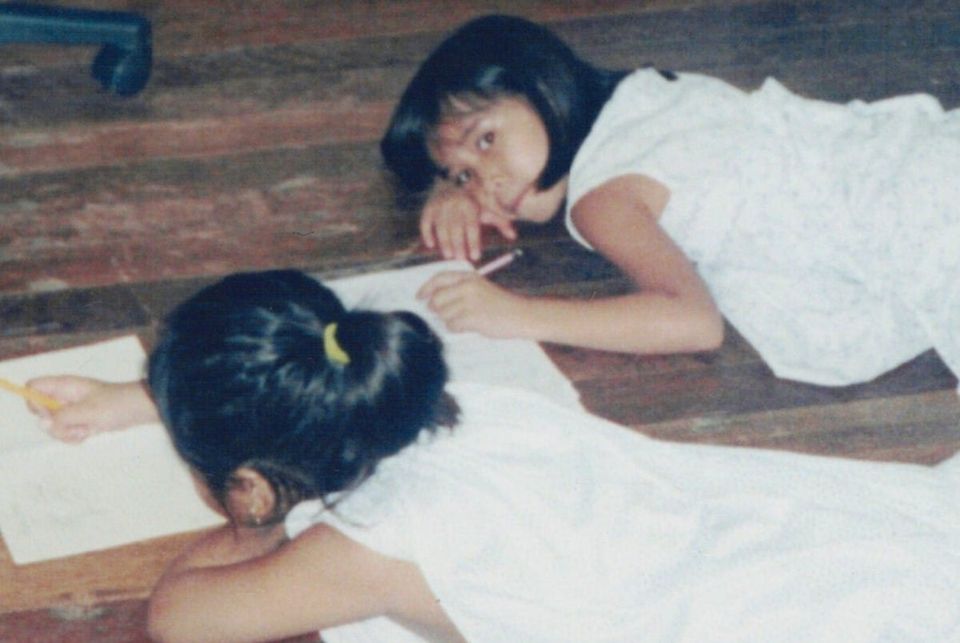
Under the spell of Robert Louis Stevenson’s A Child’s Garden of Verses, the first non-picture book I remember reading, I wrote my first poems at seven years old. I scrawled them in my large handwriting on sheets of school pad paper and collected them in an indigo plastic file folder. Centered titles, four-line stanzas. As in A Child's Garden, my poems were about play and nature through a child's eyes: running free through a meadow, speaking to a robin on an apple tree, blowing out candlelight before bed.
Thus was the power of imagination and influence, for I grew up in a small neighborhood in Metro Manila, one of the densest metropolises in the world. Cement, cracked and hot and gray, was my terroir. My encounters with nature were limited to the adrenaline rush of a massive cockroach flying into the room; our neighbor's modest garden, always green with plants I didn't even know the names of, and; the sparse trees in the park across our house. This park, with its small playground and gazebo bearing in paint the name of whatever local politician was in power, sat on the banks of the Pasig River. This once vital, life-giving river had been declared biologically dead in the nineties from industrial and household waste, and as a child I knew this through the acrid stench that would kiss my face when I peered over the edge, and the heaps of colorful garbage washed up on the sides where kids would sometimes wade into to fetch a fallen slipper or shuttlecock. Occasionally, my family would visit the provinces, like my mother's hometown in Mindanao or nearby ones with a beach or lake for a brief summer escapade, but my city-bred skin would recoil at the touch of loose earth and the scratch of grass on my soft, uncalloused feet. The crawl of lizards on the ceiling of the kubo or the incessant music of a tuko made me restless at night.
But I wrote about tumbling down a hill and befriending the North American robin because I thought that was all I was permitted to write.
Steadily, the years would continue to refract me. I'd read printed flyers in English and hear ads in rapid Tagalog from my father's default radio station. Some mornings, my mother's loud Surigaonon would sound through our thin walls as she spoke with her sister on the phone. In school, where every blackboard was crowned with a sign that commanded SPEAK ENGLISH 24 HOURS, I would be asked to pay a coin for every word in Filipino I am caught speaking as part of the campaign to make us "global citizens" (translation: highly marketable labor for Western countries). For a year or two, French and Italian classes were given almost as much time as Filipino. I was enamored by the sound of these strange tongues, and sought out foreign film and music before I even developed a real interest in local cinema. Imported culture — K-drama, anime, MMORPGs, Eurovision songs, Greek mythology, American blockbusters and TV channels — was everywhere, and I ate them all, their odd and beautiful sounds, with childlike wonder.
Reading expands the consciousness, but I found that it can shrink and distort, too. It was the primarily Anglo-American fiction I read – and it didn't help that the large bookstore chains often only had a small shelf for Filipiniana, at best – that would make the dissonance clear. In those novels, geography was described in blocks, counties, towns, and states — terms I had no conception of at the time. Is one kanto a block? Is barangay the same as a neighborhood? What the hell was a parapet? When I tried my hand at fiction, my characters would have eggs and bacon for breakfast even though I often had tocino and corned beef. I would describe my child-protagonist enjoying recess in school even though my grade school friends and I called it snack time. There were no jeepneys or tricycles in my stories, only buses, which in actuality I rarely took. I would refer to all my titas and ninangs and aunties as my aunts, even if my relationships with each were completely different. My imagined worlds were hazy mosaics that fell apart with a breath. In its place was a confusion I, for years, could not articulate. It was effacement.
In one dream, I watched from the afterlife as someone gave a eulogy at my funeral in Taglish. In another, a teenage version of myself asked an adult version of me how to say peace in French. Pais, I answered, which in my waking I know to be incorrect – the right word is paix – confusing it for the Spanish (and Tagalog) word for country: país. Both versions of myself walked to the edge of a stony cliff and looked into the foggy distance.
Yes, I suppose I did this to myself; I received my colonial inheritance with cupped hands without question, like many of us. We who are young and forgetful and aspiring only to be alive. I write this now from the belly of the empire that violently sought to shape us in its image, where I am where I am told I speak very good English – barely any accent, amazing!
If you could only feel the knots in my tongue. The chasms in my mind over which I can barely leap.
Ah, it doesn't matter now; there is no going back. I have taken this inheritance and bitten into it with angry teeth, chewed it up and spit out the cartilage. Taken from it what I can and ripped apart the membrane of forgetting. What cannot be undone I live with or bury, and in this nakedness I learn the language of my blood and spirit, pure in their impurity. Of myself I have made a chimera. Now, when I speak, I can turn stones into rivers of great herons.
Here in this conclave of rivers kung saan umaalab ang kasaysayan ng tubig I see with all my eyes the flow from shattered spring to shore: Mabagsik at mapula, exposé of acid rain, fever dream, slayer and mother of all saints.
Fundamental to the revolution and the formation of a Filipino consciousness, José Rizal's Noli Me Tangere, originally written in Spanish, is read by most Filipinos today in one of several Filipino or English translations.
About Semper Femina. Essays & poetry on living at the threshold between worlds. Here I move between the analog and the digital, the ancient and the urgent, the intimate and the strange.
Read my published poetry here.
Member discussion